This section supplements the “LIS-SV”
product manual. The parameters described here are only available if the LIS-SV
is used in an ABULiner control unit.
Overview of the
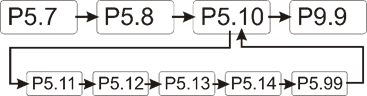
'ABULiner' parameter level
The following parameters can be set in the 'ABULiner'
parameter level of the LIS-SV.
|

|
Danger during setting work!
During setting work on the LIS-SV, monitoring of
the wire rope hoist is switched off. This means the wire rope hoist cannot
be monitored for excess load, among other things. This means the
wire rope hoist cannot be monitored for excess load, among other
things.
This in turn means the load could fall and kill or
injure people!
Do not use the crane for normal work during
setting work, and only lift loads very carefully for test
purposes! |
All LIS-SV parameters which are important for the ABULiner
are combined in a separate parameter level, which is shown as a submenu.
 Move the load hook out of
the limit switch range (up or down).
Move the load hook out of
the limit switch range (up or down).
During parameter setting, the load hook must not be within the
limit switch range.
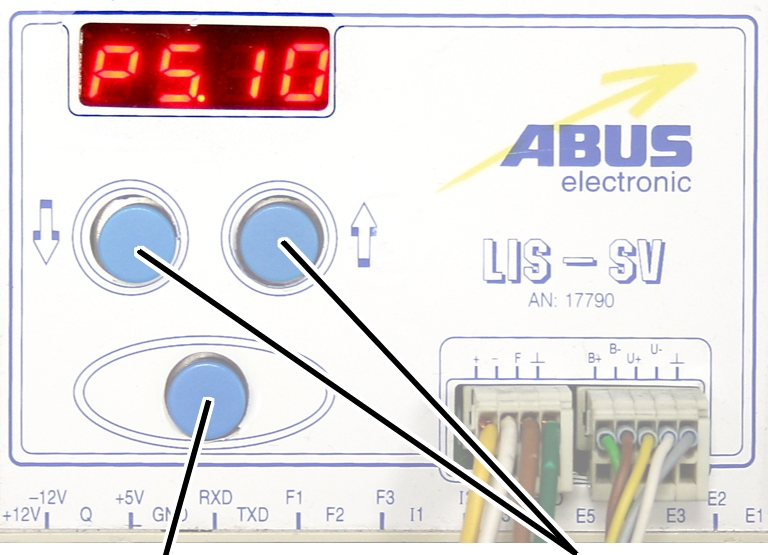
Open the menu of the
LIS-SV. See the documentation “Load indicator system LIS-SV”.
|
|
|
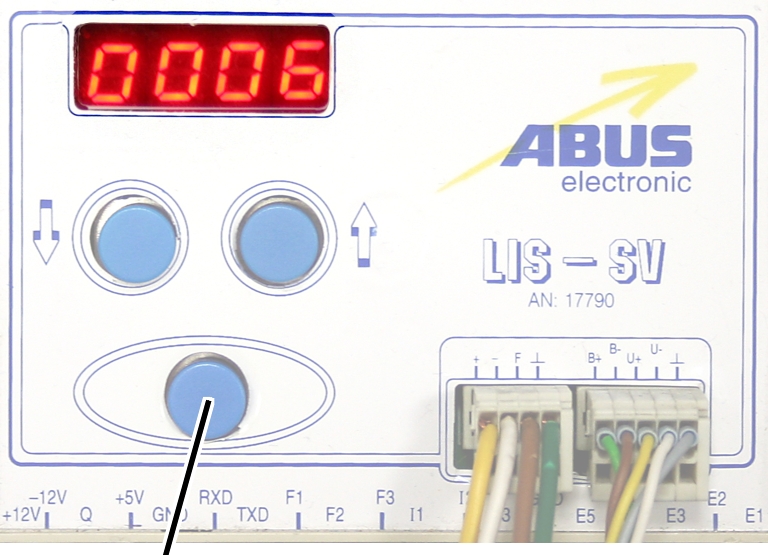
Enter
button |
Arrow
buttons |
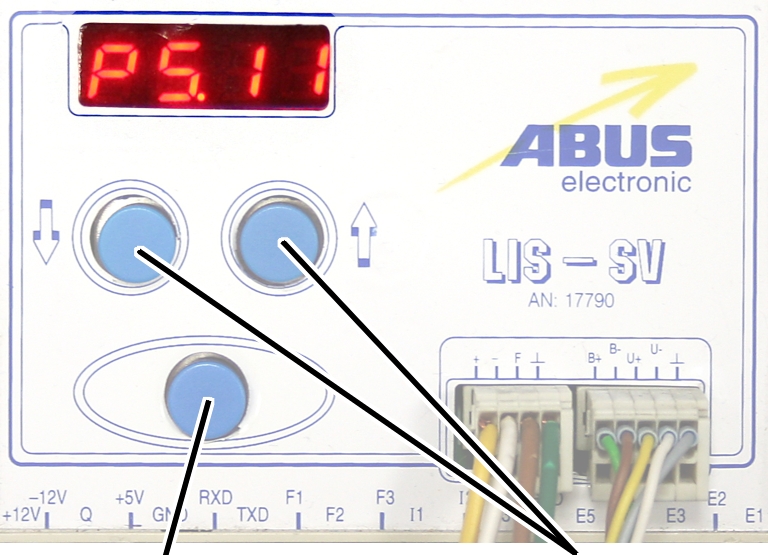
 Select parameter 5.10.
Press ENTER.
● The
'ABULiner' parameter level is activated.
● Parameter
5.11 is displayed.
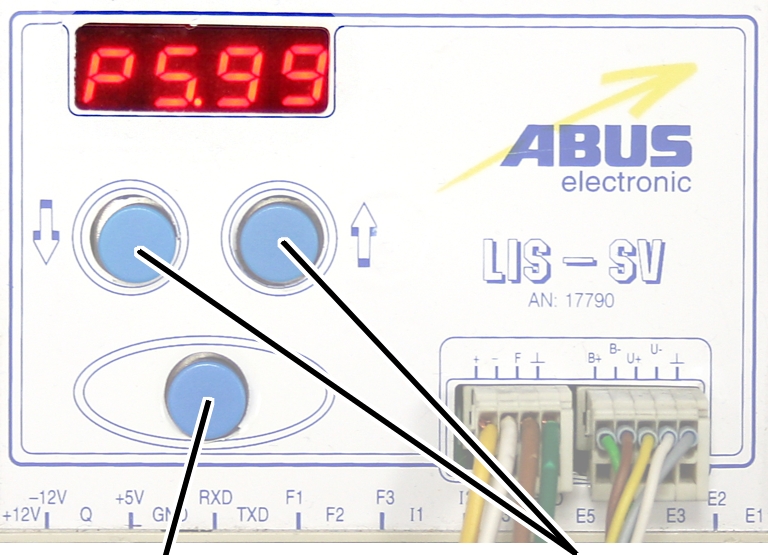
Exiting the
'ABULiner' parameter level
|
|
|
Enter
button |
Arrow
buttons |
Select parameter 5.99.
Press ENTER.
● The
previous parameter level is reactivated.
● Parameter
5.10 is displayed.
The LIS-SV is automatically activated for the ABULiner if a
value is entered for the parameter 5.11.
In the ABULiner mode (a value is set for parameter 5.11):
─ The
LIS-SV can monitor the total load for a maximum of two wire rope hoists.
─ Input F3
(normally used for measuring the load of wire rope hoist 3) now serves in
monitoring the current rotational frequency of the hoist motor.
─ A value
can be entered for parameter 3.0 (maximum load capacity of wire rope hoist 3).
If a value is entered for this, parameter 5.11 cannot be set.
─ This
interlocking thus excludes an incorrect setting.
─ The
load-controlled switching point at output TxD of the LIS-SV cannot be used.
─
Parameter 4.5 (setting for load-controlled switching point) is not available.
In the normal mode (no value is set for parameter 5.11):
─
Operation of the ABULiner Lifting/Lowering unit is not possible.
─ The
LIS-SV can monitor the total load for up to three wire rope hoists.
─ Input F3
serves in measuring the load of a third wire rope hoist.
─ A value
can be entered for parameter 5.11 (gear ratio). If a value is entered for this,
parameter 3.0 cannot be set.
─ This
interlocking thus excludes an incorrect setting.
─ The
load-controlled switching point at output TxD of the LIS-SV can be used.
─
Parameter 4.5 (setting for load-controlled switching point) can be used.
The LIS-SV uses the signal of the encoder and the gear ratio
of the hoisting gear to calculate the hook travel distance, the maximum distance
in the limit switch range and the current rotational frequency of the hoist
motor. The gear ratio must be set on the machine.
|
|
|
Cable
speed |
|
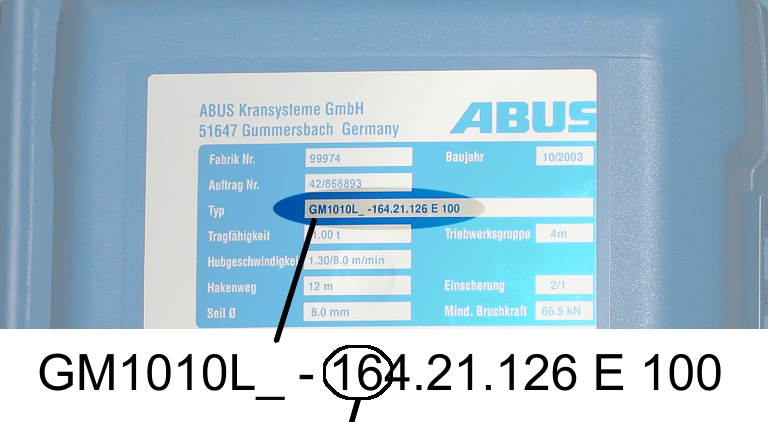
Read off the type
designation at the type plate of the wire rope hoist.
Read off the cable
speed.
From this table, select
the gear ratio that matches the cable speed.
|
|
Cable
speed |
|
Hoist motor GM |
32 m/min at 50 Hz
38 m/min at 60
Hz |
25 m/min at 50 Hz
30 m/min at 60
Hz |
20 m/min at 50 Hz
24 m/min at 60
Hz |
16 m/min at 50 Hz
19 m/min at 60
Hz |
|
800.4 |
50.01 |
63.49 |
77.77 |
98.16 |
|
800.5 |
47.03 |
60.04 |
74.66 |
95.03 |
|
1000.6 |
54.43 |
68.91 |
84.00 |
105.1 |
|
1000.7 |
54.60 |
68.06 |
81.45 |
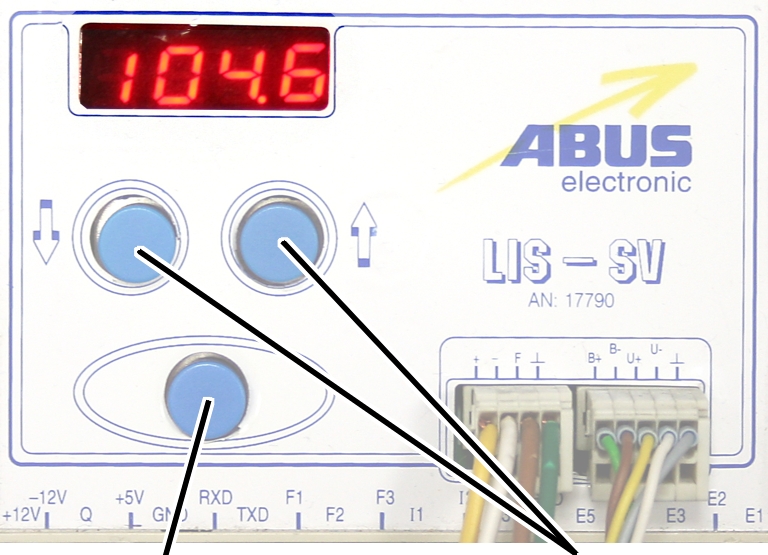
104.6 |
|
2000.3 |
58.22 |
74.23 |
91.19 |
118.4 |
|
3000.4 |
73.61 |
93.92 |
118.4 |
152.9 |
|
5000.3 |
85.14 |
109.3 |
132.8 |
169.0 |
|
5000.4 |
80.20 |
104.9 |
127.7 |
160.6 |
|
6000.3 |
94.69 |
118.5 |
149.6 |
182.7 |
|
7000.1 |
118.0 |
148.3 |
182.6 |
232.0 |
|
|
|
|
|
|
Table: Gear ratios (numerical values) depending on
hoist motor (lines) and cable speeds (columns) at 50 and 60 Hz.
|
|
|
Enter
button |
Arrow
buttons |
Move the load hook out of
the limit switch range (up or down).
During parameter setting, the load hook must not be within the
limit switch range.
Select parameter 5.11.
Press ENTER.
● The set
value is displayed.
If the value is 0.00, the function is deactivated.
● Hold ENTER
pressed.
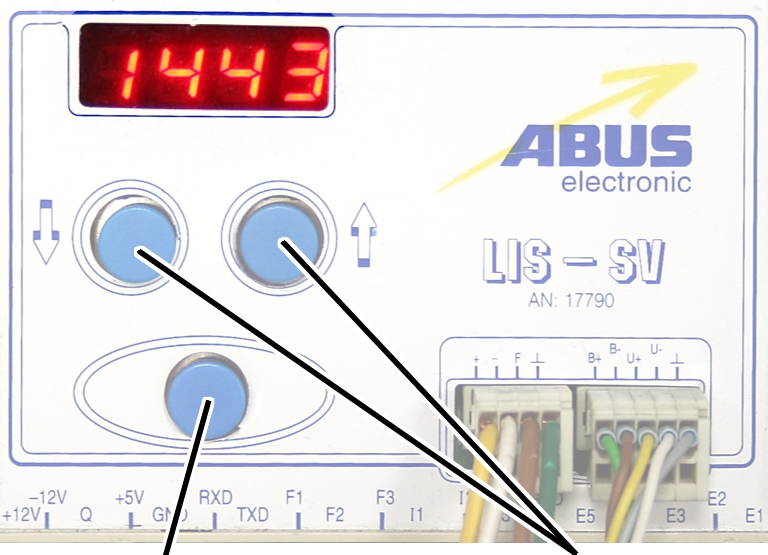
● CODE is
displayed.
Hold ENTER pressed.
|
|
|
Enter
button |
Arrow
buttons |
Enter the code 1443.
Press ENTER briefly.
|
|
|
Enter
button |
Arrow
buttons |
Set the value from the
table.
If the display ‘0.00’ cannot be changed, a value is set in
parameter 3.0. In this case, set the value to zero first.
Press ENTER briefly.
Sasur Bahu Sex Mmsmobi High Quality Jun 2026
Here, the romance is not purely physical. The storyline often begins with a helpless Bahu being mistreated by her husband and mother-in-law. Her Sasur becomes her protector. What starts as gratitude slowly turns into longing, stolen glances at the dinner table, and eventually, a secret, illicit affair conducted under the guise of familial duty.
First, let’s decode the keyword. in this context often refers to user-generated mobile content, but in the literary underground, "mobi" (short for Mobipocket, an ebook format) has become a catch-all term for short, explosive, chapter-by-chapter stories delivered directly to a smartphone.
Critics believe these shows normalize relationships that are considered socially and morally unacceptable in many cultures.
For more curated romantic content beyond these specific tropes, platforms like offer critically acclaimed Indian romantic titles such as Dum Laga Ke Haisha Kuch Kuch Hota Hai sasur bahu sex mmsmobi high quality
Stories often focus on a change in the household hierarchy.
The persistence of keywords surrounding complex or taboo family relationships reflects a broader shift in content consumption. As mobile internet accessibility continues to grow, the boundary between mainstream entertainment and niche, sensationalized digital fiction will keep evolving, driving creators to explore increasingly unconventional storylines. If you want to refine this analysis,
The Sasur Bahu relationship is a complex and sensitive topic in Indian culture, especially when it comes to romantic storylines in media. The term "Sasur Bahu" refers to the relationship between a son-in-law (sasur) and his wife's mother (bahu). In Indian society, this relationship is often portrayed as strained or complicated, with many storylines revolving around the power dynamics, emotional conflicts, and romantic tensions between the two. Here, the romance is not purely physical
The depiction of relationships between fathers-in-law and daughters-in-law in digital fiction reflects a broader trend toward more complex, multi-layered storytelling. Platforms continue to explore various facets of domestic life, focusing on the emotional depth and evolving responsibilities of each family member. As digital media grows, these stories will likely continue to adapt, reflecting the diverse experiences and interests of a global audience.
The Sasur Bahu MMSMobi phenomenon has become an integral part of Indian popular culture, reflecting changing viewer preferences and the evolving media landscape. As audiences, content creators, and regulators continue to engage with this trend, it will be fascinating to see how it shapes the future of entertainment and storytelling in India.
: Utilizing the May-December trope to explore attraction between characters of different generations. What starts as gratitude slowly turns into longing,
In these storylines, the daughter-in-law often finds herself in an unhappy, unfulfilled, or abusive marriage with a younger man (often the sasur's son). Amidst her emotional isolation, the father-in-law steps in as her primary confidant and defender. Over time, mutual respect and shared quiet moments blossom into deeper, romantic feelings. 2. The Power of Mutual Vulnerability
Mobile devices allow viewers to watch "bold" or "taboo" content in private, away from the judgmental eyes of a traditional joint family.
Only for auxiliary fans
The auxiliary fan of the hoist motor continues to run for
several minutes after the lifting or lowering. This ensures that the hoist motor
is adequately cooled even at slow lifting speeds. The run-on time can be
adjusted.
|
|
|
Enter
button |
Arrow
buttons |
Move the load hook out of
the limit switch range (up or down).
During parameter setting, the load hook must not be within the
limit switch range.
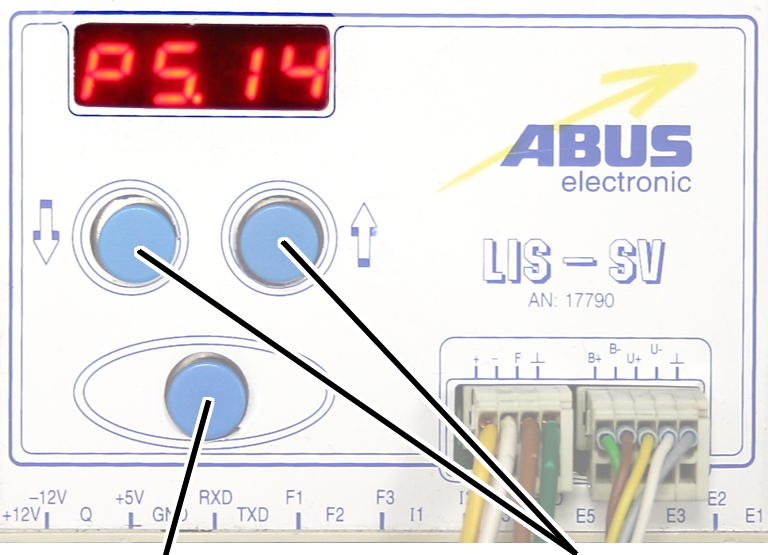
Select parameter 5.14.
Press ENTER.
● The set
value is displayed.
|
|
|
Enter
button |
|
Set the value to between 3
and 10 minutes using the arrow buttons.
Press ENTER.