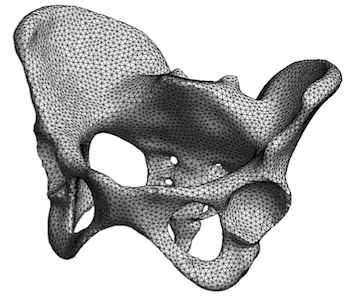
Gmsh is an open source 3D finite element mesh generator with a built-in CAD
engine and post-processor. Its design goal is to provide a fast, light and
user-friendly meshing tool with parametric input and flexible visualization
capabilities. Gmsh is built
around four modules
(geometry, mesh, solver and post-processing), which can be controlled with
the graphical user
interface, from
the command
line, using text files written in Gmsh's
own scripting
language (.geo files), or through the C++, C, Python, Julia and
Fortran application
programming interface.
See this general presentation for a high-level overview of Gmsh and the reference manual for the complete documentation, which includes the Gmsh tutorial. The source code repository contains the tutorial source files as well as many other examples.
Gmsh is distributed under the terms of the GNU General Public License (GPL):
pip install
            --upgrade gmsh
'
Make sure to read the tutorial and the FAQ before sending questions or bug reports.
git clone
          https://gitlab.onelab.info/gmsh/gmsh.git
'
pip install -i https://gmsh.info/python-packages-dev
        --force-reinstall --no-cache-dir gmsh
' (on Linux systems without
X windows, use python-packages-dev-nox instead of
python-packages-dev)
If you use Gmsh please cite the following reference in your work (books, articles, reports, etc.): C. Geuzaine and J.-F. Remacle. Gmsh: a three-dimensional finite element mesh generator with built-in pre- and post-processing facilities. International Journal for Numerical Methods in Engineering 79(11), pp. 1309-1331, 2009. You can also cite additional references for specific features and algorithms.
Please report all issues
on https://gitlab.onelab.info/gmsh/gmsh/issues.
Gmsh is copyright (C) 1997-2022 by C. Geuzaine and J.-F. Remacle (see the CREDITS file for more information) and is distributed under the terms of the GNU General Public License (GPL) (version 2 or later, with an exception to allow for easier linking with external libraries).
In short, this means that everyone is free to use Gmsh and to redistribute it on a free basis. Gmsh is not in the public domain; it is copyrighted and there are restrictions on its distribution (see the license and the related frequently asked questions). For example, you cannot integrate this version of Gmsh (in full or in parts) in any closed-source software you plan to distribute (commercially or not). If you want to integrate parts of Gmsh into a closed-source software, or want to sell a modified closed-source version of Gmsh, you will need to obtain a commercial license: please contact us for details.
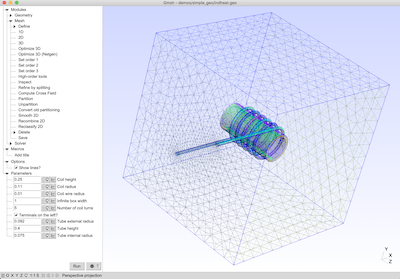
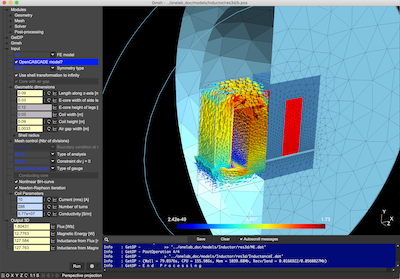
These are two screenshots of the Gmsh user interface, with either the light or dark user interface theme. See the ONELAB web site for more.
I have designed these to highlight the specific upgrades in V14 (automation, 3D integration, and cloud collaboration) while keeping the tone professional and engaging.
AccuMark is an industry-leading software suite used by fashion designers, pattern makers, and manufacturers worldwide. It provides a comprehensive digital environment to create, manipulate, and grade patterns, and to create efficient markers for cutting. Key Advancements in AccuMark Version 14
Drape the graded pieces onto a virtual avatar to verify fit consistency across all sizes, eliminating the time-consuming physical sample loop.
Features advanced search and filtering tools to easily locate design assets within massive enterprise databases. AccuMark Pattern Design (PDS) gerber accumark version 14
High-resolution tension and pressure heat maps reveal exactly where a garment might pinch, bind, or sag on the body. This visualization ensures fit accuracy before a single piece of fabric is cut. 3. Intelligent Marker Making and Nesting
Beyond the 3D "wow factor," the core 2D engine received critical updates to handle complex grading and nesting. Version 14 introduced more intuitive tools for multi-dimensional grading
This public link is valid for 7 days and shares a thread, including any personal information you added. This link or copies made by others cannot be deleted. If you share with third parties, their policies apply. Can’t copy the link right now. Try again later. I have designed these to highlight the specific
Gerber AccuMark Version 14 is a mature evolution of a legacy product. It does not chase trends; it builds infrastructure. By focusing on cloud connectivity, simplifying Made-to-Measure workflows, and integrating 3D capabilities directly into the 2D pipeline, Gerber has positioned AccuMark as the operating system for the modern factory.
What or previous version you are currently using
Easy Marking and AccuNest arrange the pieces to create high-efficiency marker files based on fabric specifications. Key Advancements in AccuMark Version 14 Drape the
Stop working harder and start working smarter. 💡
Once installed, users needed to configure the software for their specific environment:
Changes made to a 2D pattern instantly reflect on the 3D digital avatar.
[2D Pattern Created in PDS] ──> [3D Simulation Studio] ──> [AccuNest Automated Marking] ──> [Digital Plotter/Cutter] 1. Advanced 3D Simulation and Production Avatars